Which Arterial Trace Is This? A Fast-Flush Board Question and the Many Points It Teaches.
A fast-flush board question, and why the number on the monitor can lie to you.
Radial arterial line. You do a fast-flush test, the square-wave one. Watch what the trace does after you let go of the flush.
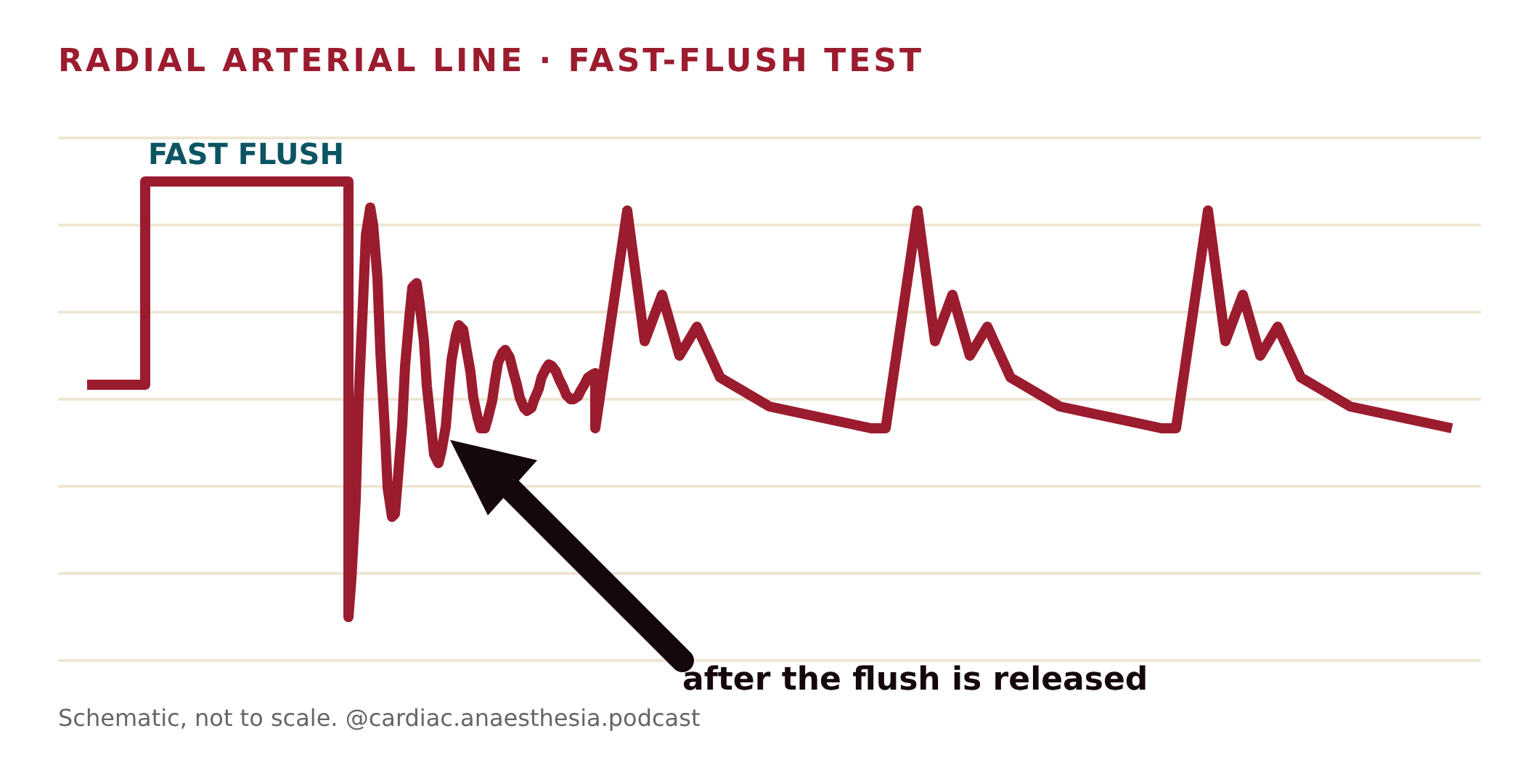
Which trace is this?
Optimally damped
Overdamped
Underdamped
Transducer levelled too low
Commit to a letter first. We ran this one as a carousel on Instagram on 10 November.
It’s C. Underdamped.
The line rings. Let go of the flush and the trace swings up and down several times before it calms down, and the beats that follow have narrow, exaggerated systolic peaks. That’s what an underdamped system is supposed to look like. Overdamping gives you something else entirely, a slurred upstroke with the detail smeared out and little or no oscillation after the flush. A levelling error, option D, can’t do this at all; it moves the reading up or down without making the trace ring. [Saugel 2020, steps 4-5]
About that “one or two oscillations” rule
Most of us were taught it. It’s a decent bedside clue and nothing more, because how a line behaves depends on its natural frequency and its damping together, and a proper assessment looks at how far apart the oscillations sit and how fast they die away. The trace should settle back into the patient’s own arterial waveform. Not to zero.
And don’t go blaming the kit just because a peak looks narrow or the dicrotic notch has gone missing. On their own, those findings prove nothing about the equipment. [Gardner 1981, pp 228, 232-235; Saugel 2020, step 5 and corrected figure 4]
What it does to the numbers
An underdamped line usually reads the systolic pressure too high and the diastolic too low, so the pulse pressure looks wider than it is. Overdamping tends to push both the other way. These are directions, though, and you can’t put a fixed size on the error. [Saugel 2020, step 5]
MAP holds up better. Damping by itself usually doesn’t shift it much, which is exactly why people reach for it, but a believable MAP still isn’t proof that the line is telling the truth. Where the transducer sits matters a great deal. Below the intended reference level, it reads high. Above it, low. That offset drags the MAP along with the systolic and diastolic, and a 10 cm height difference is worth roughly 7.5 mmHg. Get the zero wrong and you can shift all three readings the same way. [Gardner 1981, p 235; DGAI 2024, section 3.6]
So when a number surprises you, look at the patient before you reach for a drug.
Then look hard at the line. Is the waveform any good? Is the transducer at the reference level you meant, is the zero right, is the line intact? If you still aren’t sure, get a second pressure measurement to back it up, and read the MAP in the context of everything else in front of you. Just don’t let any of this hold you up when the patient really is unstable and needs treating now. [LHSC arterial-line procedure, assessment and maintenance; DGAI 2024, section 3.6]
The causes overlap more than the lists suggest
Air in the line, clot, kinks, obstruction, loose connections and a flush bag that has lost its pressure all commonly produce overdamping. You can’t reliably tell which one you’re dealing with from the shape of the wave, so check the whole system end to end. [Saugel 2020, step 5] A catheter tip lying against the vessel wall will damp the tracing as well. [UW Health paediatric arterial-line policy, 2018, p 7]
The underdamping side is messier than our slide made it look.
Extra tubing and compliant components change the natural frequency and the damping at once, so adding them doesn’t simply mean “less damping”. Keep the circuit short and stick to purpose-made parts. [Gardner 1981, pp 233-234; Saugel 2020, step 5] A small air bubble is sneakier still. It can increase the damping while it drags the natural frequency down, and the overall response can end up worse. Get the air out safely. Never add air to “fix” ringing. [Gardner 1981, p 233]
Tachycardia is a different story. A fast heart rate with a steep systolic upstroke asks more of the system’s frequency response, but it doesn’t mean the equipment’s damping coefficient has dropped. Catheter movement adds its own artefact, so it’s worth keeping the line still. [Gardner 1981, p 232; Saugel 2020, step 5]
Fixing it without hurting anyone
Go over the connections, the tubing, where the catheter sits and the pressure bag. Short, stiff tubing made for the job helps, and so does getting rid of extensions you don’t need. The review cited here describes 300 mmHg in the bag as the usual adult set-up; follow the device instructions and your own protocol. Moving the wrist can sort out a kink. Moving or replacing the catheter is a job for an appropriately trained clinician using aseptic technique. Once it’s fixed, look at the waveform again. [Saugel 2020, steps 3 and 5; LHSC arterial-line procedure]
“Flush and remove all air” must never mean flushing air or a suspected clot into the patient. If the line is blocked, don’t force it. De-air, aspirate or replace it the way your local protocol says, and repeat the fast-flush test only once it’s safe. [LHSC arterial-line procedure; St Luke’s arterial-line guideline, 2023, p 25]
Where the newer guidance stands
The 2024 DGAI/AWMF guideline for adults having non-cardiac surgery tells you to check levelling and zeroing, and to test the system’s dynamic response, a fast-flush test being one way to do it. It’s S1 expert consensus. It backs up the checks in this post, and Gardner’s damping principles from 1981 still do the heavy lifting. [DGAI 2024, sections 2 and 3.6]
References
Gardner RM. Direct blood pressure measurement: dynamic response requirements. Anesthesiology 1981;54:227-36. Full text, University of Utah
Saugel B, Kouz K, Meidert AS, Schulte-Uentrop L, Romagnoli S. How to measure blood pressure using an arterial catheter: a systematic 5-step approach. Critical Care 2020;24:172. Article; correction to figure 4
Saugel B, Annecke T, Bein B, et al. Intraoperative haemodynamic monitoring and management of adults having non-cardiac surgery: guidelines of the German Society of Anaesthesiology and Intensive Care Medicine (DGAI) in collaboration with the German Association of the Scientific Medical Societies (AWMF). Journal of Clinical Monitoring and Computing 2024;38:945-59. Article
London Health Sciences Centre (LHSC). Procedure: arterial line insertion, maintenance and dressing change. Procedure
UW Health. Arterial catheter set-up, maintenance, blood drawing and discontinuation, paediatric policy, 2018. Policy PDF
St Luke’s (HSE). Arterial lines management guideline, approved January 2023. Guideline PDF
On sources. The original carousel cited Barash’s Clinical Anesthesia, Miller’s Anesthesia and Gardner’s 1981 paper. Gardner’s article supports the physiology here. The textbook editions and pages weren’t given in the post, and I haven’t independently checked them for this piece. Saugel and colleagues’ 2020 review with its figure correction, the 2024 DGAI/AWMF guideline and the institutional arterial-line procedures were added as supporting references. The UW Health paediatric policy supports only the point about wall contact. St Luke’s document was approved in January 2023 with review due January 2026, so use your own organisation’s current controlled protocol. Institutional procedures aren’t international guidelines.
For education. Apply the cited sources in their clinical context and follow current local guidance. This isn’t patient-specific advice.
A new board-style question goes up every Tuesday on @cardiac.anaesthesia.podcast. More at cardiacanaesthesiapodcast.com.
Discussion about this post